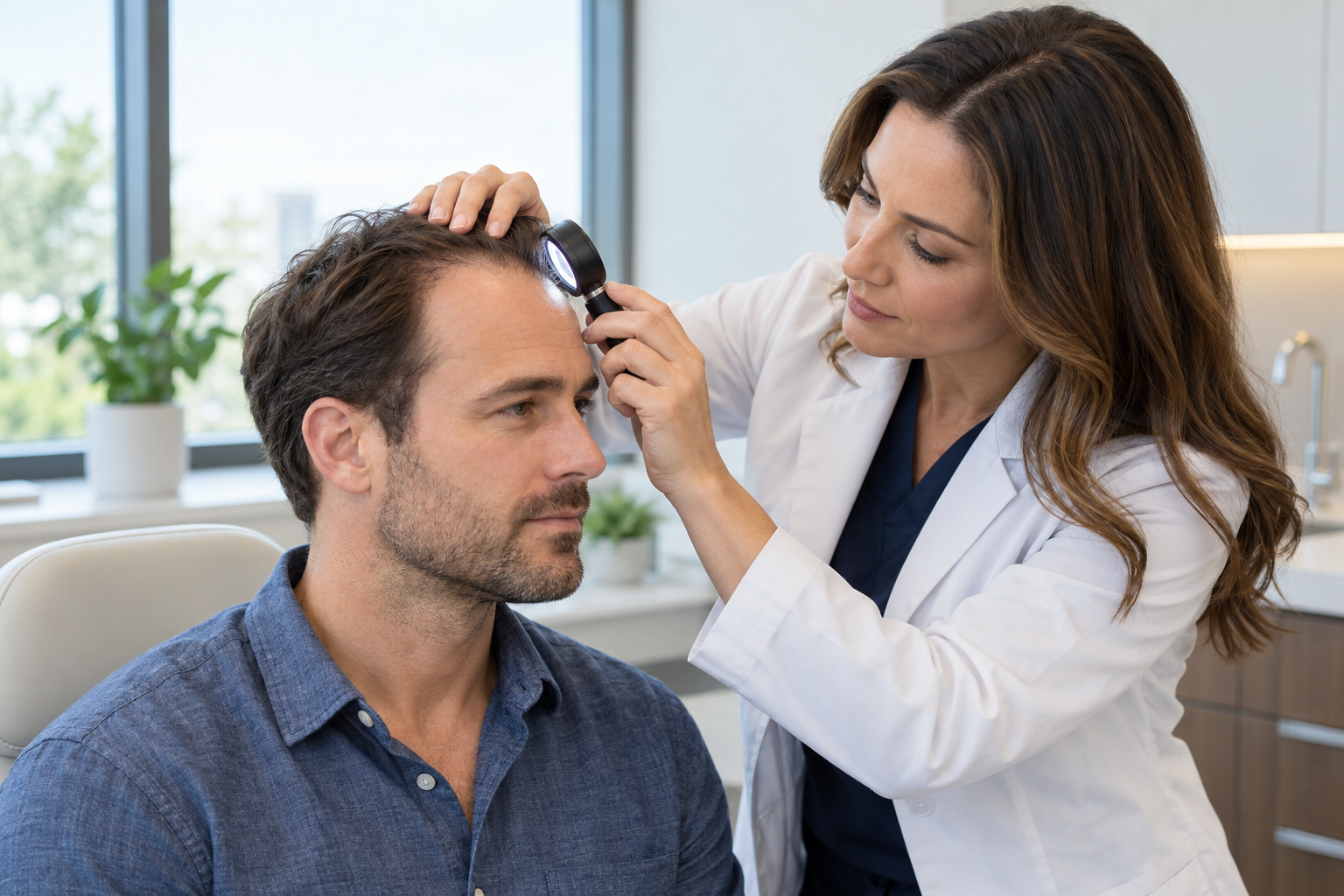
A receding hairline often develops gradually, but its cause and pattern are not the same for everyone. For some adults, hereditary pattern hair loss slowly changes the temples and frontal hairline. For others, a receding edge may be related to traction, inflammation, medication, illness, or another condition that needs a different approach. A hair transplant for a receding hairline may restore coverage when the diagnosis, donor supply, and long-term plan support surgery, but it is not the right first step for every patient.
New Jersey patients considering hairline restoration should begin with a careful medical and scalp assessment. The goal is not simply to lower the hairline. A responsible plan should account for facial proportions, existing density, the likely progression of hair loss, available donor hair, and realistic expectations for coverage.
Start With the Cause of the Receding Hairline
Male pattern hair loss, also called androgenetic alopecia, commonly appears as recession at the temples, thinning across the frontal scalp, or loss at the crown. However, a receding hairline is a visible pattern rather than a diagnosis by itself. Sudden shedding, patchy loss, scalp symptoms, eyebrow loss, or a smooth and scarred-looking hairline may call for further medical evaluation before surgery is considered.
A clinician will usually review when the change began, how quickly it is progressing, family history, current medications, previous treatments, scalp health, and the density of the donor area. Patients can also learn more about the clinic’s overview of male pattern baldness and available treatment approaches.
How a Hair Transplant Restores the Frontal Hairline
Hair transplant surgery redistributes a limited supply of follicular units from a donor area, usually the back or sides of the scalp, to areas with thinning or baldness. Follicular units are naturally occurring groups of one or more hairs. For a frontal restoration, finer single-hair grafts are generally valuable along the leading edge, while larger units may be placed behind them to build visual density.
The surgeon creates recipient sites that determine the position, direction, and angle of growth. Because the frontal hairline frames the face, small planning differences can have a large visual effect. A mature, irregular, and appropriately placed design often ages more naturally than a low, perfectly straight line.
Who May Be a Candidate?
Candidacy is individualized. A potential candidate generally needs a confirmed cause of hair loss, enough healthy donor hair, a recipient area capable of supporting transplanted follicles, and expectations that match what the available grafts can accomplish. The assessment may also consider:
- The stability and extent of the recession
- Donor density, hair caliber, curl, color contrast, and scalp laxity
- Age and the possibility of future loss behind the proposed hairline
- Prior surgery, scars, medical conditions, and medication use
- Preferred hairstyle and tolerance for donor-area scarring
- Whether medical management should be started or continued
Younger adults with an evolving pattern may be advised to stabilize or monitor their hair loss before committing donor grafts. Patients with diffuse thinning, active inflammatory scalp disease, or limited donor supply may need a different plan. A consultation cannot promise a specific graft count or result before an examination.
FUE and FUT Options for Hairline Restoration
The two main donor-harvesting approaches are follicular unit excision and follicular unit transplantation. Both can provide grafts for frontal hairline work; the better fit depends on the patient’s donor area, coverage goals, scarring preferences, and long-term strategy.
Follicular Unit Excision (FUE)
With FUE, follicular units are removed individually through small circular openings in the donor area. This avoids a single linear donor scar, although it creates many small scars that may be visible with very short hair in some patients. FUE can be useful for people who prefer shorter hairstyles or want grafts harvested without a strip incision. Learn how the clinic describes its FUE hair transplant process in New Jersey.
Follicular Unit Transplantation (FUT)
With FUT, the surgeon removes a narrow strip of donor scalp, closes the area, and has the strip divided into follicular-unit grafts. FUT leaves a linear donor scar, which is usually covered by surrounding hair, and may be considered when a patient needs a larger graft supply or wants to preserve options within a long-term donor-management plan. The clinic’s FUT hair transplant overview explains the strip-harvesting approach and consultation factors.
Neither method is automatically superior for every receding hairline. Recipient-site planning, careful graft handling, appropriate density, and future loss are as important as the harvesting method.
Designing a Natural-Looking, Age-Appropriate Hairline
A natural hairline is not a single line. It has variation, transition, and a relationship to the patient’s facial structure. During planning, the surgeon may evaluate the central forelock, temple recession, frontal density, hair direction, and the amount of donor hair that must remain available for possible future needs.
It is reasonable to ask why a proposed hairline is positioned at a certain height, how many grafts may be allocated to the frontal zone, and how the plan would look if native hair continues to thin. The clinic also offers guidance on choosing a New Jersey clinic for receding-hairline restoration, including questions about surgeon involvement, technique, and follow-up care.
What to Expect From Consultation Through Surgery
- Evaluation: The clinician reviews the hair-loss history, scalp, donor area, medical background, and goals.
- Planning: The proposed hairline, treatment area, harvesting method, approximate graft needs, limitations, costs, and alternatives are discussed.
- Procedure: Hair transplant surgery is generally performed with local anesthesia. Grafts are harvested, prepared, and placed into recipient sites according to the treatment plan.
- Aftercare: The patient receives instructions for protecting the grafts, washing, sleeping, activity, medication, and follow-up.
Before scheduling, patients should understand who performs each part of the procedure, how complications are handled, what postoperative access is available, and whether the treatment plan includes the possibility of continued native-hair loss. The clinic publishes verified background information about Dr. Dominick Golio and his surgical training.
Recovery and the Hair-Growth Timeline
Temporary redness, swelling, tenderness, and scabbing can occur after a transplant. Patients must handle the recipient area carefully during early healing and follow their own surgeon’s instructions about washing, exercise, sun exposure, headwear, and medication. Bleeding, infection, anesthesia reactions, noticeable scarring, poor growth, and an unsatisfactory cosmetic result are among the possible risks that should be discussed before surgery.
Transplanted hairs commonly shed during the first several weeks. New growth develops gradually, and visible improvement usually takes months rather than days. Maturation can continue for roughly a year, sometimes longer. Timing varies by patient and treatment area, so photographs taken under consistent lighting can help track progress without creating unrealistic comparisons.
Medical Treatment and Long-Term Planning
A transplant moves hair; it does not stop every form of ongoing hair loss. Depending on the diagnosis and medical history, a qualified clinician may discuss nonsurgical treatment to slow further thinning or support the surrounding native hair. Prescription and over-the-counter options have different benefits, contraindications, and side effects, and they should be considered with an appropriate medical professional.
Long-term planning matters because a restored frontal line can look isolated if hair behind it continues to recede. A conservative design and responsible use of donor grafts can preserve options for future treatment.
Questions to Ask During a New Jersey Consultation
- What is the likely diagnosis behind my receding hairline?
- Is my pattern stable enough for surgery?
- How was the proposed hairline position chosen?
- Why is FUE, FUT, or a nonsurgical approach recommended for me?
- What donor density and graft range are realistic after an examination?
- Who will perform the harvesting, recipient-site creation, and placement?
- What scars, downtime, risks, and follow-up should I expect?
- How does the plan account for future hair loss?
Request an Individualized Hairline Assessment
If you are considering a receding hairline transplant in Paramus or elsewhere in New Jersey, an in-person assessment can clarify the cause of your hair loss, donor capacity, surgical options, and realistic goals. Request a hair transplant consultation with The Hair Transplant Center – New Jersey to discuss whether FUE, FUT, medical management, or continued observation fits your situation.
This article is general educational information and is not a diagnosis or a substitute for individualized medical advice.